
21 Aug Is There a Single ADHD Test for Children? What Parents Should Know
Key Takeaway
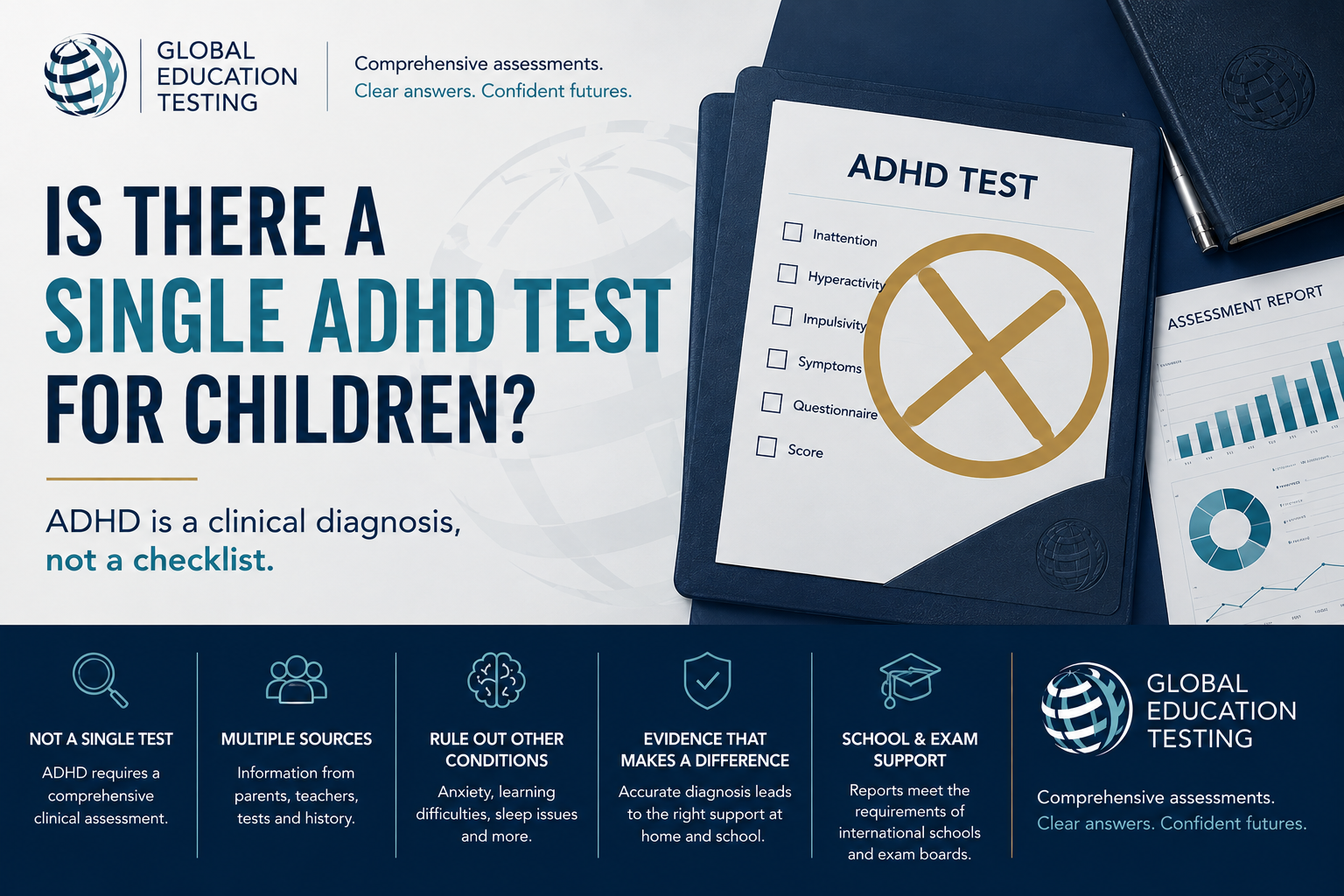
ADHD has no blood test, no brain scan and no questionnaire that produces a yes or no answer. The diagnosis describes a persistent pattern of inattention, hyperactivity or impulsivity that began in childhood, shows itself in more than one setting and interferes with a child’s learning, relationships or daily life. Each of those elements has to be established with evidence, and that evidence comes from people, records and observation over time.
“Can I just get my child tested for ADHD?”
It is one of the most common questions parents ask Global Education Testing. The answer is important because an ADHD diagnosis is not produced by a single test or questionnaire. There is no blood test, brain scan or computerised assessment that can simply confirm or rule out ADHD.
Instead, ADHD is identified through a comprehensive clinical and psychological assessment. A qualified professional considers the child’s developmental history, behaviour across different settings, academic functioning and evidence from parents and teachers, while also investigating other conditions that can produce similar difficulties.
For parents, the distinction matters. A screening questionnaire may suggest that ADHD should be investigated. A proper assessment determines whether the evidence actually supports an ADHD diagnosis and, importantly, what else may be contributing to the child’s difficulties.
Why there is no single ADHD test for children
ADHD is a neurodevelopmental disorder characterised by developmentally inappropriate and persistent patterns of inattention and/or hyperactivity and impulsivity that cause functional impairment. This cannot be established by a single test result.
Diagnostic frameworks such as the DSM-5-TR and ICD-11 require evidence that symptoms are persistent, began during childhood, occur across relevant contexts and cause meaningful impairment. The DSM-5-TR, for example, requires several symptoms to have been present before the age of 12.
This means that a child who becomes distracted during one particular lesson does not automatically have ADHD. Nor does a high score on an online ADHD questionnaire establish a diagnosis.
The Psychologist has to establish a much broader pattern:
- When did the difficulties begin?
- Are they present at home as well as at school?
- Do teachers observe the same difficulties?
- Are they affecting learning, friendships or daily functioning?
- Are the difficulties greater than would be expected for the child’s developmental stage?
- Could another condition explain the presentation?
- Could ADHD be present alongside another condition?
The answers come from multiple sources rather than from one “ADHD test”.
What happens during an ADHD assessment for a child?
A comprehensive ADHD assessment brings together several different forms of evidence. The exact assessment process varies according to the child’s age, history and presenting difficulties, but a properly conducted assessment will generally consider the following.
Developmental history
The Psychologist takes a detailed history from the parents or caregivers. This can include pregnancy and birth, early development, language development, medical history, sleep, behaviour, family history, schooling and the point at which concerns first became apparent.
Developmental history is particularly important because ADHD is a childhood-onset neurodevelopmental condition. Difficulties that appear for the first time during adolescence therefore require careful investigation rather than an assumption that they represent previously unrecognised ADHD.
Functioning across different settings
ADHD does not exist simply because a child is inattentive in a classroom.
The Psychologist considers how the child functions at school, at home, socially and during structured and unstructured activities. Information from teachers can be particularly valuable because it allows the child’s behaviour to be considered alongside the expectations and developmental norms of the classroom.
A child whose difficulties occur only during mathematics, for example, requires a different investigation from a child who consistently struggles to sustain attention across lessons, homework, conversations and everyday activities.
Standardised rating scales
Parent, teacher and student questionnaires provide structured information about symptoms and executive functioning.
Commonly used instruments include the SNAP-IV and Conners rating scales. These questionnaires allow reported behaviours to be compared with age-based norms and can help identify patterns that warrant further investigation.
They are important evidence, but they are not diagnostic verdicts.
A child can score highly on an ADHD rating scale for several reasons, including anxiety, sleep difficulties, learning difficulties or emotional distress. Conversely, a child with ADHD may not produce an obvious presentation in every setting.
Cognitive and academic assessment
A comprehensive psychoeducational assessment can examine the child’s cognitive abilities and academic attainment alongside attention and executive functioning.
This is particularly important because apparent inattention can sometimes be a consequence of an underlying learning difficulty. A child who cannot read the material being presented may appear inattentive when the underlying problem is reading or language.
Cognitive and academic testing can therefore help establish the child’s broader learning profile and identify areas requiring separate intervention.
School and other collateral evidence
School reports, teacher observations, previous assessments and relevant medical information can provide evidence that cannot be obtained from a questionnaire alone.
For international-school students, this evidence can be especially important because children may move between schools and education systems, sometimes across several countries. A properly documented developmental and educational history helps establish whether the pattern is persistent rather than specific to one school or teacher.
Differential diagnosis
This is one of the most important parts of a proper ADHD assessment.
Several conditions can produce behaviours that resemble ADHD. The assessor must consider whether the child’s difficulties are better explained by another condition, whether ADHD is present alongside another condition, or whether multiple factors are contributing simultaneously.
What can look like ADHD in children?
A child who loses equipment, forgets instructions, interrupts conversations, struggles to complete work and appears unable to sit still may have ADHD. But those same behaviours can occur for many other reasons.
A thorough assessment must consider:
- anxiety and other emotional difficulties;
- sleep problems and chronic tiredness;
- hearing or vision difficulties;
- dyslexia and other specific learning difficulties;
- developmental language disorder;
- autism;
- developmental coordination difficulties;
- trauma or significant environmental disruption;
- medical conditions;
- medication effects; and
- difficulties associated with the child’s educational environment.
The child’s developmental stage also matters. Younger children in a school year may naturally display less mature attention, organisation and self-regulation than older classmates. Developmental expectations therefore have to be considered when interpreting behaviour.
Importantly, these conditions are not necessarily alternatives to ADHD. A child can have ADHD and dyslexia. A child can have ADHD and autism. A child can have ADHD and anxiety.
Identifying the complete profile matters because treating only one part of the child’s difficulty may leave significant needs unaddressed.
Are online ADHD tests accurate?
Parents searching for an “ADHD test for children” will find hundreds of online questionnaires and symptom checklists.
These can be useful as screening tools. They can help a parent recognise that the child’s behaviour may warrant professional assessment.
But a screening result is not a diagnosis.
A questionnaire asks whether particular behaviours are present. A diagnostic assessment asks why those behaviours are present, how long they have existed, whether they occur across settings, how much impairment they cause and whether another explanation fits the evidence better.
That distinction is fundamental.
The National Institute for Health and Care Excellence (NICE) recommends that ADHD diagnosis should not be made solely on the basis of rating scales or observational data. Such tools are used as part of a broader clinical and psychosocial assessment.
An online quiz cannot obtain a developmental history, interview a teacher, examine academic attainment or perform a differential diagnosis.
If a website tells a parent that a questionnaire has definitively diagnosed their child with ADHD, the result should be treated with considerable caution.
What happens if ADHD is misdiagnosed?
The consequences of an inaccurate assessment can be significant.
If anxiety is responsible for a child’s apparent inattention, treating the presentation as ADHD alone may leave the underlying anxiety unaddressed.
If sleep deprivation is producing concentration difficulties, a behavioural intervention directed at ADHD symptoms does not solve the underlying problem.
If dyslexia is responsible for a child’s difficulty completing written work, treating the child as simply “inattentive” can allow the literacy difficulty to become increasingly entrenched.
There is also a cost to missing genuine ADHD.
Children with ADHD can spend years being described as lazy, careless, disruptive or unmotivated when the underlying difficulty has never been properly investigated. Over time, repeated academic failure and negative feedback can affect both educational attainment and a child’s perception of their own abilities.
The objective of assessment is therefore not simply to obtain an ADHD label. It is to understand why the child is struggling and identify the support that follows from that understanding.
What does an ADHD assessment provide for school?
For families in international schools, a properly documented assessment can have practical consequences beyond the diagnosis itself.
Schools need to understand how a child’s difficulties affect learning. Where examination access arrangements are being considered, examination authorities also require appropriate evidence demonstrating the student’s disability or difficulty, its functional impact and the rationale for the requested arrangements.
Depending on the student’s circumstances and the relevant examination authority, this may include arrangements such as additional time, rest breaks or use of a computer.
The requirements differ between examination systems. The International Baccalaureate, Cambridge International, Pearson Edexcel, other A-level systems and the College Board each have their own policies and evidential requirements.
A strong psychoeducational report therefore does more than state “the student has ADHD”.
It should explain the evidence supporting the conclusion, describe the functional impact on learning and identify appropriate educational recommendations. Where examination access arrangements are being considered, the report should also provide the evidence required by the relevant authority rather than assuming that a diagnosis automatically guarantees a particular accommodation.
How Global Education Testing assesses ADHD
Global Education Testing provides comprehensive online psychoeducational assessments for children and young people attending international schools.
Assessments are led by HCPC-registered educational psychologists and consider ADHD within the context of the student’s wider cognitive, academic, developmental and educational profile.
Rather than treating ADHD as an isolated checklist, the assessment examines the questions that matter:
What does the child’s developmental history show?
How does the child function across home and school?
What do parents and teachers report?
How is the child performing academically?
Are there cognitive or executive-functioning patterns that help explain the presentation?
Could another condition account for the difficulties?
Could ADHD coexist with another learning or developmental condition?
The assessment battery is selected according to the individual student’s presentation. Depending on the referral question, this may include:
WISC-V or WAIS cognitive assessment providing information about intellectual functioning and areas such as working memory and processing speed.
WIAT-III assessment of academic attainment, including reading, writing and mathematics, helping identify specific learning difficulties that may contribute to apparent inattention or academic underperformance.
CTOPP-2 assessment of phonological processing and related language-based skills, particularly relevant when dyslexia or reading difficulties are suspected.
SNAP-IV and Conners scales — structured measures of ADHD-related behaviours and associated difficulties, incorporating information from different informants where appropriate.
Executive-function assessment of areas such as planning, organisation, time management and self-regulation where these are relevant to the referral question.
MOXO Continuous Performance Test a computerised measure providing additional information about sustained attention, impulsivity and responses to distraction. It is used as one component of the assessment rather than as a standalone diagnostic test.
Taylor Complex Figure test provides additional information about visual organisation, planning and related executive processes where clinically appropriate.
The significance of these measures lies in their interpretation, not simply in the number of tests administered.
A child may have weak working memory without having ADHD. Another may have ADHD with broadly average cognitive abilities. A third may have both ADHD and dyslexia. The purpose of comprehensive assessment is to distinguish between these possibilities and describe the child’s actual profile.
ADHD assessment for international-school students
International-school students present additional considerations.
Many children are educated in English while living in countries where English is not their first language. Others have moved between multiple schools and curricula. Their educational history may include IB, Cambridge, Pearson Edexcel, A-level or other international programmes.
Assessment therefore needs to consider the language of instruction, educational history, previous interventions and the child’s experience across different school environments.
For families seeking examination access arrangements, the report also needs to be useful to the school and relevant examination authority. A diagnosis without evidence of functional impact is often insufficient to establish what support a student actually requires.
The purpose of an ADHD assessment is understanding, not simply labelling
There is no single ADHD test for children.
There is something more useful: a structured assessment that brings together developmental history, behaviour across settings, standardised measures, academic attainment, cognitive functioning, school evidence and differential diagnosis.
The objective is not simply to answer “Does my child have ADHD?”
It is to answer the more important questions: What is causing the child’s difficulties? How do those difficulties affect learning and everyday functioning? What other conditions may be present? What support does the child actually need?
For parents, that distinction is the difference between a screening result and an evidence-based assessment.
Global Education Testing provides comprehensive psychoeducational assessments for international-school students, with assessments conducted by HCPC-registered educational psychologists and reports designed to provide schools, families and other professionals with a clear evidence base for educational decision-making.

Alexander Bentley-Sutherland is the CEO of Global Education Testing, the leading provider of Learning Development Testing tailored specifically for the International and Private School community worldwide.
- Alexander Bentley-Sutherland
- Alexander Bentley-Sutherland
- Alexander Bentley-Sutherland
- Alexander Bentley-Sutherland
- Alexander Bentley-Sutherland
- Alexander Bentley-Sutherland
- Alexander Bentley-Sutherland
- Alexander Bentley-Sutherland
- Alexander Bentley-Sutherland
- Alexander Bentley-Sutherland
- Alexander Bentley-Sutherland
- Alexander Bentley-Sutherland
- Alexander Bentley-Sutherland
- Alexander Bentley-Sutherland
- Alexander Bentley-Sutherland
- Alexander Bentley-Sutherland
- Alexander Bentley-Sutherland
- Alexander Bentley-Sutherland
- Alexander Bentley-Sutherland
- Alexander Bentley-Sutherland
- Alexander Bentley-Sutherland
- Alexander Bentley-Sutherland
- Alexander Bentley-Sutherland
- Alexander Bentley-Sutherland
- Alexander Bentley-Sutherland
- Alexander Bentley-Sutherland
- Alexander Bentley-Sutherland
- Alexander Bentley-Sutherland
- Alexander Bentley-Sutherland
- Alexander Bentley-Sutherland
- Alexander Bentley-Sutherland
- Alexander Bentley-Sutherland
- Alexander Bentley-Sutherland
- Alexander Bentley-Sutherland
- Alexander Bentley-Sutherland
- Alexander Bentley-Sutherland
- Alexander Bentley-Sutherland
- Alexander Bentley-Sutherland
- Alexander Bentley-Sutherland
- Alexander Bentley-Sutherland
- Alexander Bentley-Sutherland
- Alexander Bentley-Sutherland
- Alexander Bentley-Sutherland
- Alexander Bentley-Sutherland
- Alexander Bentley-Sutherland
- Alexander Bentley-Sutherland
- Alexander Bentley-Sutherland
- Alexander Bentley-Sutherland
- Alexander Bentley-Sutherland
- Alexander Bentley-Sutherland
- Alexander Bentley-Sutherland
- Alexander Bentley-Sutherland
- Alexander Bentley-Sutherland
- Alexander Bentley-Sutherland
- Alexander Bentley-Sutherland
- Alexander Bentley-Sutherland
- Alexander Bentley-Sutherland
- Alexander Bentley-Sutherland
- Alexander Bentley-Sutherland
- Alexander Bentley-Sutherland
- Alexander Bentley-Sutherland
- Alexander Bentley-Sutherland
- Alexander Bentley-Sutherland
- Alexander Bentley-Sutherland
- Alexander Bentley-Sutherland
- Alexander Bentley-Sutherland
- Alexander Bentley-Sutherland
- Alexander Bentley-Sutherland
- Alexander Bentley-Sutherland
- Alexander Bentley-Sutherland
- Alexander Bentley-Sutherland
- Alexander Bentley-Sutherland
- Alexander Bentley-Sutherland
- Alexander Bentley-Sutherland
- Alexander Bentley-Sutherland
- Alexander Bentley-Sutherland
- Alexander Bentley-Sutherland
- Alexander Bentley-Sutherland
- Alexander Bentley-Sutherland
- Alexander Bentley-Sutherland
- Alexander Bentley-Sutherland
- Alexander Bentley-Sutherland
- Alexander Bentley-Sutherland
- Alexander Bentley-Sutherland
- Alexander Bentley-Sutherland
- Alexander Bentley-Sutherland
- Alexander Bentley-Sutherland
- Alexander Bentley-Sutherland
- Alexander Bentley-Sutherland
- Alexander Bentley-Sutherland
- Alexander Bentley-Sutherland
- Alexander Bentley-Sutherland
- Alexander Bentley-Sutherland
- Alexander Bentley-Sutherland
- Alexander Bentley-Sutherland
- Alexander Bentley-Sutherland
- Alexander Bentley-Sutherland
- Alexander Bentley-Sutherland
- Alexander Bentley-Sutherland
- Alexander Bentley-Sutherland
- Alexander Bentley-Sutherland
- Alexander Bentley-Sutherland
- Alexander Bentley-Sutherland
- Alexander Bentley-Sutherland
- Alexander Bentley-Sutherland
- Alexander Bentley-Sutherland
- Alexander Bentley-Sutherland
- Alexander Bentley-Sutherland
- Alexander Bentley-Sutherland
- Alexander Bentley-Sutherland
- Alexander Bentley-Sutherland
- Alexander Bentley-Sutherland
- Alexander Bentley-Sutherland
- Alexander Bentley-Sutherland
- Alexander Bentley-Sutherland
- Alexander Bentley-Sutherland
- Alexander Bentley-Sutherland
- Alexander Bentley-Sutherland
- Alexander Bentley-Sutherland
- Alexander Bentley-Sutherland
- Alexander Bentley-Sutherland
- Alexander Bentley-Sutherland
- Alexander Bentley-Sutherland
- Alexander Bentley-Sutherland
- Alexander Bentley-Sutherland
- Alexander Bentley-Sutherland
- Alexander Bentley-Sutherland
- Alexander Bentley-Sutherland
- Alexander Bentley-Sutherland
- Alexander Bentley-Sutherland
- Alexander Bentley-Sutherland
- Alexander Bentley-Sutherland
- Alexander Bentley-Sutherland
- Alexander Bentley-Sutherland
- Alexander Bentley-Sutherland
- Alexander Bentley-Sutherland
- Alexander Bentley-Sutherland
- Alexander Bentley-Sutherland
- Alexander Bentley-Sutherland
- Alexander Bentley-Sutherland
- Alexander Bentley-Sutherland
- Alexander Bentley-Sutherland
- Alexander Bentley-Sutherland
- Alexander Bentley-Sutherland
- Alexander Bentley-Sutherland
- Alexander Bentley-Sutherland
- Alexander Bentley-Sutherland
- Alexander Bentley-Sutherland
- Alexander Bentley-Sutherland
- Alexander Bentley-Sutherland
- Alexander Bentley-Sutherland
- Alexander Bentley-Sutherland
- Alexander Bentley-Sutherland
- Alexander Bentley-Sutherland
- Alexander Bentley-Sutherland
- Alexander Bentley-Sutherland
- Alexander Bentley-Sutherland
- Alexander Bentley-Sutherland
- Alexander Bentley-Sutherland
- Alexander Bentley-Sutherland
- Alexander Bentley-Sutherland
- Alexander Bentley-Sutherland
- Alexander Bentley-Sutherland
- Alexander Bentley-Sutherland
- Alexander Bentley-Sutherland
- Alexander Bentley-Sutherland
- Alexander Bentley-Sutherland
- Alexander Bentley-Sutherland
- Alexander Bentley-Sutherland
- Alexander Bentley-Sutherland
- Alexander Bentley-Sutherland
- Alexander Bentley-Sutherland
- Alexander Bentley-Sutherland
- Alexander Bentley-Sutherland
- Alexander Bentley-Sutherland
- Alexander Bentley-Sutherland
- Alexander Bentley-Sutherland
- Alexander Bentley-Sutherland
- Alexander Bentley-Sutherland
- Alexander Bentley-Sutherland
- Alexander Bentley-Sutherland
- Alexander Bentley-Sutherland
- Alexander Bentley-Sutherland
- Alexander Bentley-Sutherland
- Alexander Bentley-Sutherland
- Alexander Bentley-Sutherland
- Alexander Bentley-Sutherland
- Alexander Bentley-Sutherland
- Alexander Bentley-Sutherland
- Alexander Bentley-Sutherland
- Alexander Bentley-Sutherland
- Alexander Bentley-Sutherland
- Alexander Bentley-Sutherland
- Alexander Bentley-Sutherland
- Alexander Bentley-Sutherland
- Alexander Bentley-Sutherland
- Alexander Bentley-Sutherland
- Alexander Bentley-Sutherland
- Alexander Bentley-Sutherland
- Alexander Bentley-Sutherland
- Alexander Bentley-Sutherland
- Alexander Bentley-Sutherland
- Alexander Bentley-Sutherland
- Alexander Bentley-Sutherland
- Alexander Bentley-Sutherland
- Alexander Bentley-Sutherland
- Alexander Bentley-Sutherland
- Alexander Bentley-Sutherland
- Alexander Bentley-Sutherland
- Alexander Bentley-Sutherland
- Alexander Bentley-Sutherland
- Alexander Bentley-Sutherland
- Alexander Bentley-Sutherland
- Alexander Bentley-Sutherland
- Alexander Bentley-Sutherland
- Alexander Bentley-Sutherland
- Alexander Bentley-Sutherland
- Alexander Bentley-Sutherland
- Alexander Bentley-Sutherland
- Alexander Bentley-Sutherland
- Alexander Bentley-Sutherland
- Alexander Bentley-Sutherland
- Alexander Bentley-Sutherland
- Alexander Bentley-Sutherland
- Alexander Bentley-Sutherland
- Alexander Bentley-Sutherland
- Alexander Bentley-Sutherland
- Alexander Bentley-Sutherland
- Alexander Bentley-Sutherland
- Alexander Bentley-Sutherland
- Alexander Bentley-Sutherland
- Alexander Bentley-Sutherland
- Alexander Bentley-Sutherland
- Alexander Bentley-Sutherland
- Alexander Bentley-Sutherland
- Alexander Bentley-Sutherland
- Alexander Bentley-Sutherland
- Alexander Bentley-Sutherland
- Alexander Bentley-Sutherland
- Alexander Bentley-Sutherland
- Alexander Bentley-Sutherland
- Alexander Bentley-Sutherland
- Alexander Bentley-Sutherland
- Alexander Bentley-Sutherland
- Alexander Bentley-Sutherland
- Alexander Bentley-Sutherland
- Alexander Bentley-Sutherland
- Alexander Bentley-Sutherland
- Alexander Bentley-Sutherland
- Alexander Bentley-Sutherland
- Alexander Bentley-Sutherland
- Alexander Bentley-Sutherland
- Alexander Bentley-Sutherland
- Alexander Bentley-Sutherland
- Alexander Bentley-Sutherland
- Alexander Bentley-Sutherland
- Alexander Bentley-Sutherland
- Alexander Bentley-Sutherland
- Alexander Bentley-Sutherland
- Alexander Bentley-Sutherland
- Alexander Bentley-Sutherland
- Alexander Bentley-Sutherland
- Alexander Bentley-Sutherland
- Alexander Bentley-Sutherland
- Alexander Bentley-Sutherland
- Alexander Bentley-Sutherland
- Alexander Bentley-Sutherland
- Alexander Bentley-Sutherland
- Alexander Bentley-Sutherland
- Alexander Bentley-Sutherland
- Alexander Bentley-Sutherland
- Alexander Bentley-Sutherland
- Alexander Bentley-Sutherland
- Alexander Bentley-Sutherland
- Alexander Bentley-Sutherland
- Alexander Bentley-Sutherland
- Alexander Bentley-Sutherland
- Alexander Bentley-Sutherland
- Alexander Bentley-Sutherland
- Alexander Bentley-Sutherland
- Alexander Bentley-Sutherland
- Alexander Bentley-Sutherland
- Alexander Bentley-Sutherland
- Alexander Bentley-Sutherland
- Alexander Bentley-Sutherland
- Alexander Bentley-Sutherland
- Alexander Bentley-Sutherland
- Alexander Bentley-Sutherland
- Alexander Bentley-Sutherland
- Alexander Bentley-Sutherland
- Alexander Bentley-Sutherland
- Alexander Bentley-Sutherland
- Alexander Bentley-Sutherland
- Alexander Bentley-Sutherland
- Alexander Bentley-Sutherland
- Alexander Bentley-Sutherland
- Alexander Bentley-Sutherland
- Alexander Bentley-Sutherland
- Alexander Bentley-Sutherland
- Alexander Bentley-Sutherland
- Alexander Bentley-Sutherland
- Alexander Bentley-Sutherland
- Alexander Bentley-Sutherland
- Alexander Bentley-Sutherland
- Alexander Bentley-Sutherland
- Alexander Bentley-Sutherland
- Alexander Bentley-Sutherland
- Alexander Bentley-Sutherland
- Alexander Bentley-Sutherland
- Alexander Bentley-Sutherland
- Alexander Bentley-Sutherland
- Alexander Bentley-Sutherland
- Alexander Bentley-Sutherland
- Alexander Bentley-Sutherland
- Alexander Bentley-Sutherland
- Alexander Bentley-Sutherland
- Alexander Bentley-Sutherland
- Alexander Bentley-Sutherland
- Alexander Bentley-Sutherland
- Alexander Bentley-Sutherland
- Alexander Bentley-Sutherland
- Alexander Bentley-Sutherland
- Alexander Bentley-Sutherland
- Alexander Bentley-Sutherland
- Alexander Bentley-Sutherland
- Alexander Bentley-Sutherland
- Alexander Bentley-Sutherland
- Alexander Bentley-Sutherland
- Alexander Bentley-Sutherland
- Alexander Bentley-Sutherland
- Alexander Bentley-Sutherland
- Alexander Bentley-Sutherland
- Alexander Bentley-Sutherland
- Alexander Bentley-Sutherland
- Alexander Bentley-Sutherland
- Alexander Bentley-Sutherland
- Alexander Bentley-Sutherland
- Alexander Bentley-Sutherland
- Alexander Bentley-Sutherland
- Alexander Bentley-Sutherland
- Alexander Bentley-Sutherland
- Alexander Bentley-Sutherland
- Alexander Bentley-Sutherland
- Alexander Bentley-Sutherland
- Alexander Bentley-Sutherland
- Alexander Bentley-Sutherland
- Alexander Bentley-Sutherland
- Alexander Bentley-Sutherland
- Alexander Bentley-Sutherland
- Alexander Bentley-Sutherland
- Alexander Bentley-Sutherland
- Alexander Bentley-Sutherland
- Alexander Bentley-Sutherland
- Alexander Bentley-Sutherland
- Alexander Bentley-Sutherland
- Alexander Bentley-Sutherland
- Alexander Bentley-Sutherland
- Alexander Bentley-Sutherland
- Alexander Bentley-Sutherland
- Alexander Bentley-Sutherland
- Alexander Bentley-Sutherland
- Alexander Bentley-Sutherland
- Alexander Bentley-Sutherland
- Alexander Bentley-Sutherland
- Alexander Bentley-Sutherland
- Alexander Bentley-Sutherland
- Alexander Bentley-Sutherland
- Alexander Bentley-Sutherland
- Alexander Bentley-Sutherland
- Alexander Bentley-Sutherland
- Alexander Bentley-Sutherland
- Alexander Bentley-Sutherland
- Alexander Bentley-Sutherland
- Alexander Bentley-Sutherland
- Alexander Bentley-Sutherland
- Alexander Bentley-Sutherland
- Alexander Bentley-Sutherland
- Alexander Bentley-Sutherland
- Alexander Bentley-Sutherland
- Alexander Bentley-Sutherland
- Alexander Bentley-Sutherland
- Alexander Bentley-Sutherland
- Alexander Bentley-Sutherland
- Alexander Bentley-Sutherland
- Alexander Bentley-Sutherland
- Alexander Bentley-Sutherland
- Alexander Bentley-Sutherland
- Alexander Bentley-Sutherland
- Alexander Bentley-Sutherland
- Alexander Bentley-Sutherland
- Alexander Bentley-Sutherland
- Alexander Bentley-Sutherland
- Alexander Bentley-Sutherland
- Alexander Bentley-Sutherland
- Alexander Bentley-Sutherland
- Alexander Bentley-Sutherland
- Alexander Bentley-Sutherland
- Alexander Bentley-Sutherland
- Alexander Bentley-Sutherland
- Alexander Bentley-Sutherland
- Alexander Bentley-Sutherland
- Alexander Bentley-Sutherland
- Alexander Bentley-Sutherland
- Alexander Bentley-Sutherland
- Alexander Bentley-Sutherland
- Alexander Bentley-Sutherland
- Alexander Bentley-Sutherland
- Alexander Bentley-Sutherland
- Alexander Bentley-Sutherland
- Alexander Bentley-Sutherland
- Alexander Bentley-Sutherland
- Alexander Bentley-Sutherland
- Alexander Bentley-Sutherland
- Alexander Bentley-Sutherland
- Alexander Bentley-Sutherland
- Alexander Bentley-Sutherland
- Alexander Bentley-Sutherland
- Alexander Bentley-Sutherland
- Alexander Bentley-Sutherland
- Alexander Bentley-Sutherland
- Alexander Bentley-Sutherland
- Alexander Bentley-Sutherland
- Alexander Bentley-Sutherland
- Alexander Bentley-Sutherland
- Alexander Bentley-Sutherland
- Alexander Bentley-Sutherland
- Alexander Bentley-Sutherland
- Alexander Bentley-Sutherland
- Alexander Bentley-Sutherland
- Alexander Bentley-Sutherland
- Alexander Bentley-Sutherland
- Alexander Bentley-Sutherland
- Alexander Bentley-Sutherland
- Alexander Bentley-Sutherland
- Alexander Bentley-Sutherland
- Alexander Bentley-Sutherland
- Alexander Bentley-Sutherland
- Alexander Bentley-Sutherland
- Alexander Bentley-Sutherland
- Alexander Bentley-Sutherland
- Alexander Bentley-Sutherland
- Alexander Bentley-Sutherland
- Alexander Bentley-Sutherland
- Alexander Bentley-Sutherland
- Alexander Bentley-Sutherland
- Alexander Bentley-Sutherland
- Alexander Bentley-Sutherland
- Alexander Bentley-Sutherland
- Alexander Bentley-Sutherland
- Alexander Bentley-Sutherland
- Alexander Bentley-Sutherland
- Alexander Bentley-Sutherland
- Alexander Bentley-Sutherland
- Alexander Bentley-Sutherland
- Alexander Bentley-Sutherland
- Alexander Bentley-Sutherland
- Alexander Bentley-Sutherland
- Alexander Bentley-Sutherland
- Alexander Bentley-Sutherland
- Alexander Bentley-Sutherland
- Alexander Bentley-Sutherland
- Alexander Bentley-Sutherland
- Alexander Bentley-Sutherland
- Alexander Bentley-Sutherland
- Alexander Bentley-Sutherland
- Alexander Bentley-Sutherland
- Alexander Bentley-Sutherland
- Alexander Bentley-Sutherland
- Alexander Bentley-Sutherland
- Alexander Bentley-Sutherland
- Alexander Bentley-Sutherland
- Alexander Bentley-Sutherland
- Alexander Bentley-Sutherland
- Alexander Bentley-Sutherland
- Alexander Bentley-Sutherland
- Alexander Bentley-Sutherland
- Alexander Bentley-Sutherland
- Alexander Bentley-Sutherland
- Alexander Bentley-Sutherland
- Alexander Bentley-Sutherland
- Alexander Bentley-Sutherland
- Alexander Bentley-Sutherland
- Alexander Bentley-Sutherland
- Alexander Bentley-Sutherland
- Alexander Bentley-Sutherland
- Alexander Bentley-Sutherland
- Alexander Bentley-Sutherland
- Alexander Bentley-Sutherland
- Alexander Bentley-Sutherland
- Alexander Bentley-Sutherland
- Alexander Bentley-Sutherland
- Alexander Bentley-Sutherland
- Alexander Bentley-Sutherland
- Alexander Bentley-Sutherland
- Alexander Bentley-Sutherland
- Alexander Bentley-Sutherland
- Alexander Bentley-Sutherland
- Alexander Bentley-Sutherland
- Alexander Bentley-Sutherland
- Alexander Bentley-Sutherland
- Alexander Bentley-Sutherland
- Alexander Bentley-Sutherland
- Alexander Bentley-Sutherland
- Alexander Bentley-Sutherland
- Alexander Bentley-Sutherland
- Alexander Bentley-Sutherland
- Alexander Bentley-Sutherland
- Alexander Bentley-Sutherland
- Alexander Bentley-Sutherland
- Alexander Bentley-Sutherland