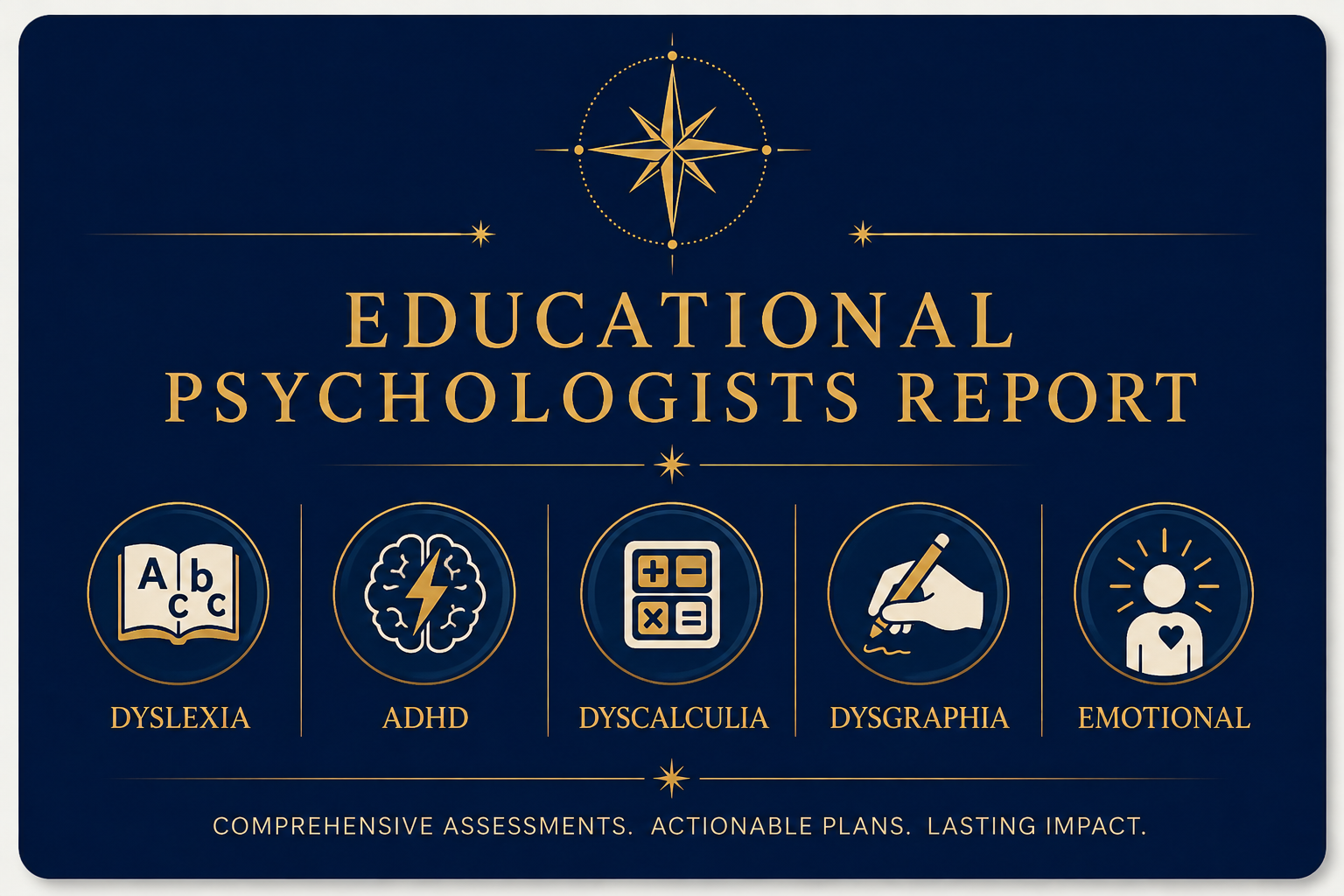

Comprehensive Educational Psychologist reports for Dyslexia, Dyscalculia, ADHD and all Specific Learning Difficulties to DSM-5-TR and ICD-11 standards. Immediately actionable education plans for school and home, backed by our Acceptance Guarantee for exam accommodations such as extra time at iGCSE, A Level, IB, SAT, ACT and university entrance worldwide. Delivered by HCPC Educational Psychologists within 7-days.


Our comprehensive psychoeducational assessment reports meet and exceed the documentation requirements of all major international examination boards including International Baccalaureate, IGCSE, A Level, AP, GED, SAT & PSAT. Whether your student is sitting IB exams in Switzerland, applying to Oxford from Dubai, taking the MCAT in the United States, or pursuing medicine in Australia, our assessment reports provide the documentation required by admissions offices and examination boards worldwide.
We specialize in testing for Neurodivergent conditions such as Dyslexia, Dyscalculia, and Dysgraphia, as well as ADHD, Anxiety & Stress related factors that may impact or delay a student in achieving their full academic potential. By focusing on early detection we help students and International Schools overcome barriers to learning. With a team of experienced highly qualified HCPC educational psychologists, we deliver high-quality, evidence based asseessment services that provide clear, actionable insights for families, schools and universities.
A comprehensive psychoeducational evaluation is the most thorough assessment of how a student learns, thinks, and functions. It is the foundation from which every accurate diagnosis and every effective plan is built.
It does two things at once. It identifies the specific profile behind an academic difficulty. And it produces the evidence needed to secure the right support, at home, in the classroom and for exams.
A comprehensive psychoeducational assessment is a thorough, multi-dimensional evaluation that examines how your child learns, thinks, and functions across multiple domains. It begins with understanding your child’s cognitive abilities (their reasoning, memory, and problem-solving skills) and then examines how these abilities translate into academic achievement in reading, writing, and mathematics.
Beyond this foundation, the assessment explores executive functioning (the “brain manager” skills like planning, organization, and working memory), attention and behavioral patterns, and emotional wellbeing including anxiety and depression. Rather than looking at these areas in isolation, a comprehensive assessment reveals how they interconnect and influence one another.
The power of our assessment is in its integration. By examining your child through multiple lenses (standardized testing, behavioral rating scales, emotional measures, and real-time observations) we can identify patterns that explain your child’s unique learning profile. This allows us to distinguish whether academic difficulties stem from cognitive processing challenges like dyslexia or dyscalculia, attention problems such as ADHD, executive function weaknesses, or emotional factors like anxiety.
This complete picture helps us understand not just what your child struggles with, but why, and more importantly, guides us toward targeted interventions, appropriate accommodations, and strategies that align with your child’s specific strengths and needs. The goal is to ensure your child receives the right support to reach their full potential.
Children in international schools often present complex profiles. They may be educated in a language different from their home language, have gaps in their education from school transitions, or show apparent difficulties that are actually related to multilingualism rather than learning disorders. Our psychologists understand these nuances and differentiate between learning differences and the natural challenges of international education.
Our Gold Standard battery of testing is designed to identify EAL from SEN because the instruments isolate what language exposure affects from what it cannot. Vocabulary scores fall in any child still acquiring the language of instruction. Fluid reasoning, working memory, processing speed and phonological processing do not. Phonological difficulties and slow naming speed persist in every language a child speaks. Strong nonverbal reasoning with weaker vocabulary points to language exposure. Weak phonological processing and working memory with intact reasoning points to a learning disorder, and no amount of English instruction will resolve it.

Our Educational Psychologists work with International schools and families, conducting assessments for students in IB, British, American, and other international curricula. We understand multilingual learners, the demands of different exam boards, and the documentation requirements needed for academic accommodations worldwide.