
18 Oct Understanding Comprehensive Educational Psychology Assessments
Understanding Comprehensive Educational Psychology Assessments: A Complete Guide for Parents
When a child struggles in school, shows unexpected difficulties with learning, or exhibits behavioral challenges that impact their academic progress, parents often hear the recommendation: “Your child needs a psychoeducational assessment.” But what exactly does this mean? What does the process involve, and how can it help your child? This guide will walk you through everything you need to know about comprehensive educational psychology assessments and why they represent the gold standard in understanding how children learn.
What Is a Comprehensive Psychoeducational Assessment?
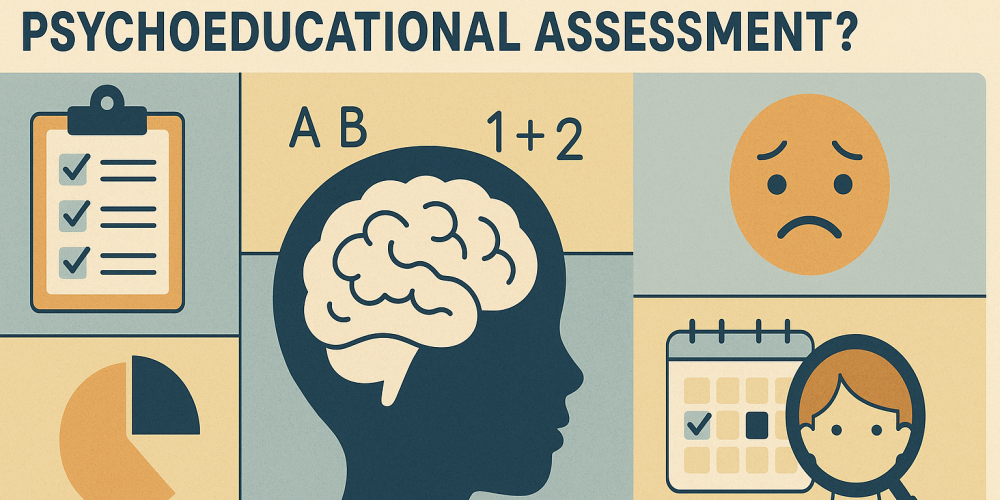
A comprehensive psychoeducational assessment is a thorough, multi-dimensional evaluation that examines how your child learns, thinks, and functions across multiple domains. It begins with understanding your child’s cognitive abilities: their reasoning, memory, and problem-solving skills, and then examines how these abilities translate into academic achievement in reading, writing, and mathematics. Beyond this foundation, the assessment explores executive functioning (the “brain manager” skills like planning, organization, and working memory), attention and behavioral patterns, and emotional wellbeing including anxiety and depression. Rather than looking at these areas in isolation, a comprehensive assessment reveals how they interconnect and influence one another.
The power of this assessment lies in its integration. By examining your child through multiple lenses (standardized testing, behavioral rating scales, emotional measures, and real-time observations), we can identify patterns that explain your child’s unique learning profile.
For instance, it helps us distinguish whether academic difficulties stem from cognitive processing challenges, attention patterns, executive function differences, or emotional factors like anxiety. This complete picture allows us to understand not just what your child might struggle with, but why, and more importantly, guides us toward targeted interventions, appropriate accommodations, and strategies that align with your child’s specific strengths and needs. The goal is to ensure your child receives the right support to reach their full potential.
Why Psychologist-Led Assessment Is Non-Negotiable
Well-meaning school staff and non-psychologist “assessors” may administer individual tests, but they lack the clinical training to interpret complex profiles, conduct differential diagnosis, or understand the nuanced interplay between cognitive, emotional, and behavioral factors. A reading screener administered by a SENCO might identify a problem exists, but cannot determine whether difficulties stem from dyslexia, processing speed deficits, working memory limitations, attention issues, or anxiety, each requiring entirely different interventions. Piecemeal testing by unqualified individuals leads to incomplete pictures, missed diagnoses, inappropriate recommendations, and ultimately, children who don’t receive the targeted support they actually need.
Why Comprehensive Assessment Matters
“Parents often come to us looking for a simple answer to a complex question,” explains Alexander Bentley-Sutherland, Managing Partner at Global Education Testing. “They might say, ‘We just need a dyslexia test’ or ‘Can you test for ADHD?’ But learning challenges are rarely that straightforward. A child who appears inattentive might actually have anxiety. Reading struggles might stem from processing speed issues, working memory limitations, or true phonological deficits. Without comprehensive evaluation, we risk misdiagnosis, incomplete intervention plans, and ultimately, a child who doesn’t get the specific support they need. Our commitment is to see the whole child, understand their complete profile, and provide families with actionable insights that make a real difference.”
This comprehensive approach distinguishes quality assessment from simple screening. While individual tests can identify that a problem exists, only integrated evaluation can explain why difficulties are occurring and what specific supports will be most effective.
The Building Blocks: What Gets Assessed
A truly comprehensive educational psychology assessment examines multiple interconnected domains. Let’s explore each component and how they work together to create a complete picture of your child’s learning profile.
The Foundation: Understanding How Your Child Thinks and Learns
WISC (Wechsler Intelligence Scale for Children) provides the cognitive foundation. This assessment examines how your child processes information, reasons, remembers, and solves problems. Think of it as understanding the “engine” specifications. The WISC doesn’t just produce a single IQ number; it breaks down cognitive functioning into specific areas:
- Verbal Comprehension: How well your child understands and uses language-based reasoning
- Visual Spatial: Your child’s ability to understand and manipulate visual information
- Fluid Reasoning: How your child solves novel problems and identifies patterns
- Working Memory: Your child’s capacity to hold and manipulate information mentally
- Processing Speed: How efficiently your child processes simple information
Understanding these different cognitive processes is essential because children can have significant variability across these areas. A child might have excellent reasoning abilities but slow processing speed, or strong visual-spatial skills but weaker verbal comprehension. These patterns provide crucial insights into learning strengths and challenges.
WIAT (Wechsler Individual Achievement Test) shows how that cognitive engine translates into academic performance in reading, writing, and mathematics. This reveals whether achievement matches potential, or if there’s a disconnect. When we compare cognitive abilities to academic achievement, we can identify specific learning difficulties. For example, a child with strong cognitive abilities but significantly lower reading achievement may have dyslexia. A child with solid reading and math skills but very poor written expression might have a specific writing disorder (dysgraphia).
The WIAT provides detailed information about:
- Reading: Word reading accuracy, reading fluency, and reading comprehension
- Written Expression: Spelling, sentence composition, and essay writing
- Mathematics: Math problem-solving, numerical operations, and math fluency
- Oral Language: Listening comprehension and oral expression
The Executive Control Center
Executive functions are the “brain manager” skills that allow us to plan, organize, initiate tasks, sustain attention, shift between activities, and monitor our own performance. These skills are absolutely critical for academic success, yet they’re often overlooked in limited assessments.
Executive Function Screening (through rating scales completed by parents and teachers) captures how your child’s executive functions operate in real-world settings. Does your child have difficulty getting started on tasks? Struggle to keep materials organized? Have trouble remembering multi-step directions? These ratings provide essential information about daily functioning.
Taylor Complex Figures Test examines your child’s visual-spatial organization and planning strategies through a drawing task. When copying a complex geometric figure, does your child approach it systematically, starting with the overall structure? Or do they get lost in details, drawing individual elements without seeing how they connect? When asked to recall the figure from memory later, how much do they remember and how organized is their reproduction? This test reveals planning approaches, organizational strategies, visual memory, and attention to detail.
These executive function assessments explain how your child approaches tasks, not just what they know. A child might have the cognitive ability to do the work but lack the executive function skills to organize their approach, remember all the steps, or monitor their progress. Understanding these patterns is essential for developing effective support strategies.
The Behavioral and Attention Picture
Attention difficulties and behavioral challenges can significantly impact learning, but they can also be symptoms of other underlying issues. Comprehensive assessment helps distinguish between primary attention disorders and attention problems that result from other factors.
SNAP (Swanson, Nolan, and Pelham Rating Scale) and Conners capture ADHD symptoms and behavioral patterns across settings, particularly comparing home and school environments. These standardized rating scales, completed by parents and teachers, assess:
- Inattention symptoms (difficulty sustaining attention, easily distracted, difficulty following through)
- Hyperactivity symptoms (fidgeting, difficulty staying seated, excessive talking)
- Impulsivity symptoms (difficulty waiting turn, interrupting others, acting without thinking)
- Related concerns like learning problems, executive function difficulties, and peer relationship issues
By gathering information from multiple sources and settings, we can determine whether attention or behavioral issues are pervasive or situation-specific, which has important implications for diagnosis and intervention.
The Emotional Landscape
Emotional wellbeing and mental health significantly impact learning and behavior. Anxiety can look like inattention. Depression can manifest as lack of motivation or poor academic performance. Without assessing the emotional domain, we risk missing crucial factors affecting your child’s functioning.
RCADS (Revised Children’s Anxiety and Depression Scale) measures specific types of anxiety (separation anxiety, social phobia, generalized anxiety, panic disorder, obsessive-compulsive symptoms) as well as depression symptoms. This helps identify whether emotional factors are contributing to academic or behavioral difficulties. Many parents are surprised to learn that their child’s “laziness” or “lack of effort” is actually anxiety about making mistakes, or that irritability and opposition might reflect underlying depression.
Rotter Incomplete Sentences (a projective assessment where children complete sentence stems like “I wish…” or “My father…”) gives insight into your child’s thoughts, feelings, self-perception, and emotional adjustment. This provides the internal narrative that rating scales might miss. How does your child see themselves? What worries them? How do they view their relationships with family, peers, and teachers? What are their hopes and fears?
Understanding your child’s emotional landscape is essential not only for accurate diagnosis but also for developing interventions that address the whole child, not just academic skills.
The Integration: Observations
Throughout the assessment process, the psychologist observes how all these factors play out in real-time. How does your child respond to challenge? What happens when a task becomes frustrating? What strategies do they use to solve problems? How do they approach easy versus difficult tasks? Do they seek help when needed or give up quickly? How do emotions affect their performance?
These behavioral observations provide context for test scores and help the psychologist understand how different factors interact. A child might perform differently when anxious versus calm, when tasks are timed versus untimed, or when given verbal versus visual instructions. These observations are crucial for developing practical, real-world recommendations.
From Assessment to Action: What Happens Next
After testing is complete, the psychologist integrates all the data to create a comprehensive report, typically 20-30 pages, that includes:
- Detailed results from all assessments with clear explanations
- An integrated summary that explains your child’s unique learning profile
- Diagnostic impressions if criteria are met for specific diagnoses (such as Specific Learning Disorder in reading/dyslexia, ADHD, anxiety disorders, etc.)
- Specific, actionable recommendations tailored to your child’s needs
These recommendations typically address multiple settings and may include:
School-Based Accommodations and Interventions:
- Extended time on tests and assignments
- Preferential seating to minimize distractions
- Breaks during lengthy tasks
- Access to assistive technology (text-to-speech, speech-to-text, graphic organizers)
- Modified homework or assignment load
- Specific instructional strategies (multisensory reading instruction, explicit strategy instruction, scaffolded writing support)
- Eligibility for formal accommodation plans such as 504 Plans, IEPs, or examination access arrangements
Home-Based Strategies:
- Organizational systems and routines
- Homework support approaches
- Behavioral management strategies
- Environmental modifications
Clinical Recommendations:
- Cognitive-behavioral therapy for anxiety or depression
- Executive function coaching
- Social skills groups
- Medication evaluation when appropriate
- Specialized tutoring or academic interventions
Why Your Child’s “Dyslexia Test” Might Be Worthless: The Hidden Cost of Cut-Rate Assessment
Many organizations offer limited screening or single-domain testing at attractive prices. SENCOs conduct in-school assessments. Tutors offer “dyslexia screening.” Independent assessors advertise quick turnaround times. While these may seem convenient and cost-effective, they fundamentally cannot provide what your child needs, and the consequences of inadequate assessment can follow your child for years.
The Qualification Gap Nobody Talks About
Here’s an uncomfortable truth: diagnosing learning difficulties, ADHD, autism, and other neurodevelopmental conditions requires specialized psychological training that SENCOs, tutors, and general “assessors” simply do not possess. These individuals may be well-meaning, experienced educators, and genuinely care about children—but good intentions cannot substitute for professional qualification.
A comprehensive psychoeducational assessment is a thorough evaluation examining how your child learns, thinks, and functions across cognitive abilities, academic achievement, executive functioning, attention, behavior, and emotional wellbeing. Unlike isolated testing, it reveals how these domains interconnect and influence one another in your child’s unique profile. This level of analysis requires years of postgraduate training in psychological assessment, psychometrics, differential diagnosis, and clinical interpretation.
Global Education Testing’s assessments are completed exclusively by educational psychologists holding the protected title of Practitioner Psychologist. This isn’t marketing language, it’s a legal qualification requiring a doctorate-level degree, supervised practice, and ongoing professional development.
Our assessments meet the highest international standards and are accepted globally by schools, examination boards, and universities worldwide precisely because they are conducted by qualified professionals who understand not just how to administer tests, but how to interpret complex profiles and make accurate diagnoses.
What Under-Qualified Assessors Cannot Do
Well-meaning school staff and non-psychologist “assessors” may administer individual tests, but they categorically lack the clinical training to interpret complex profiles, conduct differential diagnosis, or understand the nuanced interplay between cognitive, emotional, and behavioral factors. Consider this scenario: a reading screener administered by a SENCO identifies that a problem exists. But it cannot determine whether difficulties stem from dyslexia, processing speed deficits, working memory limitations, attention issues, visual processing problems, or anxiety masquerading as reading difficulty. Each of these requires entirely different interventions.
This matters profoundly. Symptoms overlap dramatically across conditions. A child who appears inattentive might have ADHD or anxiety, or depression, or be profoundly bored in an unchallenging classroom. Reading struggles might reflect true dyslexia or working memory deficits, slow processing speed, inadequate instruction, or perfectionist anxiety about making mistakes. Without comprehensive psychological evaluation, you’re essentially guessing, and guessing wrong means months or years of ineffective interventions while your child falls further behind and their confidence erodes.
Piecemeal testing by unqualified individuals leads to incomplete pictures, missed diagnoses, inappropriate recommendations, and ultimately, children who don’t receive the targeted support they actually need. Only comprehensively trained psychologists possess the expertise to integrate multiple data sources, distinguish between overlapping conditions, and provide the rigorous documentation required for formal accommodations and diagnoses.
Why Comprehensive Assessment Is Non-Negotiable
Accurate Diagnosis Through Differential Assessment: Symptoms overlap across conditions. Only comprehensive psychological assessment allows for proper differential diagnosis, ensuring your child receives the correct identification rather than a best guess based on limited information.
Understanding the “Why” Behind Struggles: Knowing that your child struggles with reading is minimally useful. Understanding whether the difficulty stems from phonological processing deficits, slow processing speed, working memory limitations, attention problems, or anxiety is essential—because each requires completely different intervention approaches. A reading intervention designed for dyslexia will be ineffective for a child whose reading struggles stem from anxiety or working memory deficits.
Whole-Child Understanding: Children are complex. Their cognitive abilities, academic skills, executive functions, attention, behavior, and emotions all interact in ways that isolated testing cannot capture. A child with strong reasoning abilities but slow processing speed needs different support than a child with working memory limitations or executive function challenges. Comprehensive assessment reveals these interactions and their educational implications.
Targeted, Evidence-Based Interventions: Generic recommendations rarely produce optimal results and often waste precious time during critical developmental windows. When we understand your child’s specific cognitive and emotional profile, we can recommend interventions precisely matched to their needs, maximizing effectiveness and minimizing wasted resources. This specificity is impossible without comprehensive evaluation by a qualified psychologist.
Documentation That Actually Works: Many schools and testing organizations reject accommodation requests based on incomplete or inadequately documented assessments. A thorough psychoeducational assessment conducted by a qualified psychologist provides the necessary evidence and professional rationale for recommended supports. Our assessments stand up to scrutiny by educational institutions, medical professionals, and examination boards worldwide because they follow established professional standards and best practice guidelines.
Baseline for Meaningful Progress Monitoring: Comprehensive assessment establishes a detailed baseline that allows meaningful measurement of growth and response to intervention over time. This longitudinal perspective is essential for adjusting supports and understanding your child’s developmental trajectory.
Peace of Mind and Clarity: Perhaps most importantly, comprehensive psychological assessment gives parents genuine clarity rather than partial answers and lingering doubts. You understand your child’s learning profile completely. You know what’s happening and why. You have a clear, evidence-based roadmap forward. This understanding brings tremendous relief and empowerment, replacing anxiety and confusion with actionable insight and appropriate support.
The True Cost of “Saving Money”
Families sometimes choose cheaper, limited screening to save money, only to return months or years later for comprehensive assessment after interventions based on incomplete information have failed. They’ve now spent more money, lost valuable time during critical developmental periods, and watched their child’s confidence diminish as ineffective supports failed to help.
The investment in comprehensive psychological assessment by a qualified practitioner psychologist isn’t an expense, it’s insurance against misdiagnosis, wasted interventions, and years of preventable struggle. Your child deserves assessment that meets international professional standards, provides accurate diagnosis, and leads to genuinely effective support.
Accepting anything less than psychologist-led comprehensive assessment is accepting second-best for your child’s future. At Global Education Testing, we refuse to compromise on professional standards because your child’s educational trajectory is too important for shortcuts.
Taking the Next Step
If your child is struggling academically, showing unexplained difficulties with learning, or experiencing behavioral or emotional challenges that impact school performance, a comprehensive psychoeducational assessment can provide the clarity and direction you need. The assessment process typically spans several hours across multiple sessions, creating a low-stress environment where your child can demonstrate their true abilities.
At Global Education Testing, our commitment is to provide thorough, professional assessment that respects the complexity of learning and honors the uniqueness of each child. We don’t just test; we understand. We don’t just identify problems; we provide solutions. And we don’t just write reports; we partner with families to ensure children get the support they need to thrive.
Understanding how your child learns is the first step toward helping them reach their full potential. A comprehensive educational psychology assessment provides that understanding, creating a foundation for success that will serve your child throughout their educational journey and beyond.

Alexander Bentley-Sutherland is the CEO of Global Education Testing, the leading provider of Learning Development Testing tailored specifically for the International and Private School community worldwide.
- This author does not have any more posts.