
24 mai Mon enfant peut-il être placé dans une classe inférieure lors de son inscription dans une autre école internationale ?
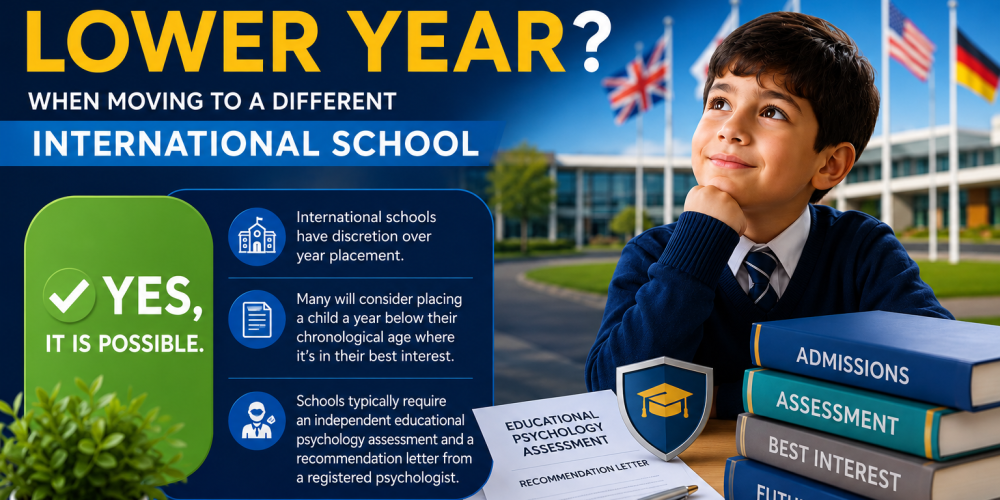
Oui, c'est possible. Les écoles internationales ont généralement une certaine latitude quant au niveau scolaire et beaucoup envisagent de placer un enfant dans une classe inférieure à son âge réel s'il existe des preuves documentées que ce placement est dans son intérêt supérieur. Les preuves généralement exigées par l'école sont une évaluation psychologique scolaire indépendante accompagnée d'une lettre de recommandation d'un psychologue agréé.
Une famille ayant récemment contacté Global Education Testing se prépare à déménager de Shanghai aux Émirats arabes unis. Leur fils, âgé de sept ans et actuellement en CP à Shanghai, serait normalement placé en CM1 dans le système scolaire de Cambridge à Dubaï, compte tenu de son âge.
Le parent a écrit : « Il est le plus jeune de sa classe et rencontre des difficultés à l’école. Nous pensons qu’un passage en CE2 lui serait bénéfique pour favoriser son développement. » Ils ont demandé si un psychologue scolaire indépendant pouvait l’évaluer et fournir une lettre de recommandation à l’appui de leur demande de changement de classe.
C'est l'une des questions les plus fréquemment posées à Global Education Testing par les familles en situation de mobilité internationale. Cette même question revient souvent de la part de familles qui déménagent entre Madrid et Genève, Singapour et Londres, Hong Kong et Chiang Mai, Bangkok et Riyad. Les pays et les programmes scolaires diffèrent, certes, mais la question de fond reste la même.
Pourquoi le choix de l'année scolaire devient une question lors d'un déménagement
Les cycles scolaires internationaux ne sont pas uniformes d'un pays à l'autre ni selon les programmes. Le système britannique prévoit de la 1re à la 13e année, dès l'âge de cinq ans. Le système américain va de la maternelle à la 12e année, dès l'âge de six ans. Le système espagnol commence l'école primaire obligatoire à six ans. Le système chinois commence en 1re année à six ou sept ans, selon l'établissement. Le Programme primaire du Baccalauréat International (IB) est structuré par âge, mais son interprétation varie selon les pays d'accueil.
Lorsqu'une famille change d'établissement scolaire, l'âge de l'enfant le place souvent dans une classe qui ne correspond pas à son niveau scolaire ou à son développement. Par défaut, la nouvelle école place l'enfant en fonction de son âge. La famille peut avoir de bonnes raisons de demander un autre placement. L'école examinera généralement la demande si les éléments justificatifs sont pertinents.
Trois scénarios courants amènent à poser la question du placement en année.
L'enfant né en été ou le benjamin de sa classe. Un enfant qui a toujours été le plus jeune de son année scolaire, qui a trouvé les exigences scolaires et sociales difficiles et qui bénéficierait d'une année avec des camarades légèrement plus âgés, dans l'année inférieure.
L’enfant qui a progressé trop vite. Un enfant qui a commencé l’école tôt, ou dont l’établissement précédent a accéléré son parcours scolaire, mais dont le profil académique et émotionnel correspondrait à une année correspondant à son âge chronologique dans un autre établissement.
L'enfant qui passe d'un cursus scolaire à un autre, avec des âges de début différents. Un enfant dont le cursus précédent a débuté sa scolarité formelle plus tard ou plus tôt que prévu par le système d'accueil.
Dans chaque cas, la famille ne demande pas une faveur à l'école. Elle lui demande simplement de prendre une décision d'affectation qui tienne compte de l'enfant réel et non de la date figurant sur son passeport.
Qu’est-ce qu’une évaluation psychoéducative complète ?
Une évaluation psychoéducative complète est une évaluation approfondie conçue pour comprendre comment un enfant apprend, pense, réussit sur le plan scolaire et fonctionne sur les plans émotionnel et comportemental.
L'évaluation examine les capacités cognitives telles que le raisonnement, la mémoire, le traitement de l'information et la résolution de problèmes, ainsi que les compétences scolaires en lecture, en écriture et en mathématiques. Elle explore également les fonctions exécutives, l'attention, le bien-être émotionnel, l'anxiété, le comportement et le développement socio-émotionnel afin de dresser un portrait complet du profil d'apprentissage de l'enfant.
En intégrant des tests standardisés, des mesures comportementales, des observations et une interprétation clinique, l'évaluation permet d'identifier si les difficultés sont liées à des troubles tels que la dyslexie, le TDAH, la dysgraphie, l'autisme, des faiblesses des fonctions exécutives, des difficultés de vitesse de traitement, l'anxiété ou d'autres différences d'apprentissage.
Pour les élèves des écoles internationales, les évaluations prennent également en compte l'impact du multilinguisme, des transitions scolaires et de l'éducation interculturelle, permettant de distinguer les véritables troubles d'apprentissage des difficultés normales liées à l'éducation internationale.
Il en résulte une compréhension détaillée non seulement des difficultés rencontrées par l'enfant, mais aussi des raisons de ces difficultés, permettant ainsi des recommandations ciblées, des aménagements scolaires et des interventions qui favorisent les progrès scolaires à long terme, la confiance en soi et le bien-être.
Ce que l'établissement d'accueil souhaite voir
Les politiques de placement par année scolaire varient d'une école internationale à l'autre, mais le document généralement demandé est une évaluation psychoéducative indépendante qui comprend une recommandation spécifique concernant le placement par année.
L'évaluation fournit à l'équipe des admissions et à l'équipe de soutien à l'apprentissage de l'école trois éléments essentiels.
Un profil cognitif permet de situer l'enfant par rapport aux autres enfants du même âge chronologique et de l'âge prévu pour son inscription. Le WISC-V ou le WAIS produisent des scores standardisés et des rangs percentiles pour la compréhension verbale, le raisonnement visuo-spatial, le raisonnement fluide, la mémoire de travail et la vitesse de traitement. L'établissement d'accueil peut ainsi identifier précisément le profil cognitif de l'enfant.
Un profil académique qui établit le niveau réel de l'enfant en lecture, en écriture et en mathématiques par rapport à ses pairs du même âge. La troisième édition du WIAT produit des scores standardisés pour chaque domaine académique. Un enfant qui, selon son âge, serait en CM1 (Year 4) mais dont le niveau scolaire correspond à celui du CE1 (Year 2) dispose de preuves objectives justifiant un placement en classe inférieure.
Un profil émotionnel et comportemental qui décrit comment l'enfant vit sa scolarité. Les échelles d'évaluation de Conners et SNAP, le test de phrases incomplètes de Rotter pour adolescents (pour les enfants plus âgés) et l'observation clinique permettent d'appréhender le bien-être de l'enfant. Un enfant en difficulté scolaire rencontre souvent aussi des difficultés émotionnelles, et le rapport rend compte de ces deux aspects.
La lettre de recommandation est le document que l'établissement scolaire demande généralement en complément du rapport. Elle expose l'avis professionnel du psychologue sur la question d'orientation, en s'appuyant sur les conclusions de l'évaluation.
Cette recommandation peut-elle servir de preuve ?
Oui. Une recommandation d'un psychologue scolaire agréé par le HCPC est reconnue par les écoles internationales britanniques du monde entier et par la plupart des systèmes scolaires internationaux, quel que soit le pays d'accueil. Le HCPC est l'organisme de réglementation statutaire des psychologues scolaires au Royaume-Uni. Les écoles internationales dispensant le programme britannique, le programme IB ou le programme américain acceptent systématiquement les évaluations réalisées par un psychologue scolaire agréé par le HCPC comme preuve externe valable.
Pour les familles qui déménagent dans une école internationale de Cambridge, l'évaluation peut également appuyer les futures demandes d'aménagement d'accès à Cambridge sans qu'il soit nécessaire de la répéter.
Pour les familles qui déménagent dans une école britannique utilisant le système Pearson Edexcel, cette évaluation facilite les demandes d'aménagement d'accès au JCQ plus tard dans le parcours scolaire de l'élève.
Pour les familles qui déménagent dans une école proposant le Programme primaire (PP) ou le Programme d'éducation intermédiaire (PEI) de l'IB, l'évaluation soutient les demandes d'aménagement inclusif de l'IB lorsque l'élève atteint le Programme du diplôme.
Pour les familles qui déménagent dans une école suivant un programme américain, cette évaluation soutient les demandes d'aménagements auprès du College Board pour les examens SAT et AP.
Le rapport est structuré de manière à satisfaire aux exigences de tous ces systèmes au sein d'un seul document.
Que se passe-t-il si l'élève n'a pas été formellement identifié comme ayant une difficulté d'apprentissage ?
L'évaluation d'orientation en première année ne requiert pas de diagnostic préalable. Il ne s'agit pas d'un simple exercice de diagnostic, mais d'un profil complet dressant un tableau des fonctions cognitives, scolaires et émotionnelles de l'enfant. À partir de ce profil, le psychologue formule une recommandation concernant son orientation.
Si l'évaluation révèle une difficulté d'apprentissage ( dyslexie , dyscalculie, dysgraphie, TDAH , anxiété ou profil du spectre autistique), le rapport le documente et l'équipe de soutien à l'apprentissage de l'école dispose des éléments diagnostiques nécessaires pour planifier le soutien dès le premier jour.
Si l'évaluation ne révèle aucune différence d'apprentissage sous-jacente mais confirme que l'enfant fonctionne en dessous des attentes pour son âge chronologique, le rapport appuie la demande de placement dans l'année scolaire sur des bases développementales plutôt que diagnostiques.
L'une ou l'autre de ces issues conforte la famille dans ses échanges avec l'établissement d'accueil.
Comment Global Education Testing traite cette demande
Global Education Testing a travaillé avec de nombreuses familles internationales mobiles pour les aider à répondre aux questions relatives au placement scolaire.
L'évaluation psychoéducative complète est réalisée par liaison vidéo sécurisée par des psychologues scolaires agréés par le HCPC, le processus complet s'étalant sur 21 jours, de la demande initiale à la remise du rapport écrit et de la lettre de recommandation.
L'évaluation comprend une batterie de tests cognitifs, une batterie de tests scolaires, des mesures des fonctions exécutives et de l'attention, des mesures du fonctionnement émotionnel et un rapport diagnostique intégré. Si la famille demande une recommandation de placement pour un an, le psychologue fournit une lettre de recommandation distincte, jointe au rapport, exposant son avis sur le placement et les éléments qui le justifient.
Le rapport de 20 à 30 pages est basé sur les critères du DSM-5-TR et de la CIM-11, rédigé en anglais et structuré pour satisfaire aux exigences de l'établissement destinataire, quel que soit le pays ou le programme scolaire.
Pour les familles qui déménagent à l'étranger, le modèle de prestation en ligne est la solution idéale. L'évaluation peut être réalisée avant, pendant ou après le déménagement. Le rapport et la lettre de recommandation peuvent être envoyés directement à l'établissement scolaire d'accueil. La famille n'a pas besoin d'attendre d'être installée dans le nouveau pays pour entamer les démarches.
Prochaines étapes
Les familles souhaitant faire évaluer leur placement en année scolaire peuvent contacter Global Education Testing via le formulaire de recommandation . L'accès est immédiat et le processus complet dure 21 jours.

Alexander Bentley-Sutherland est le PDG de Global Education Testing, le principal fournisseur de tests de développement de l'apprentissage spécialement conçus pour la communauté des écoles internationales et privées du monde entier.
- Cet auteur n'a plus de messages.