
09 Jul What Cucurella’s Transfer Tells Us About Autism Assessment
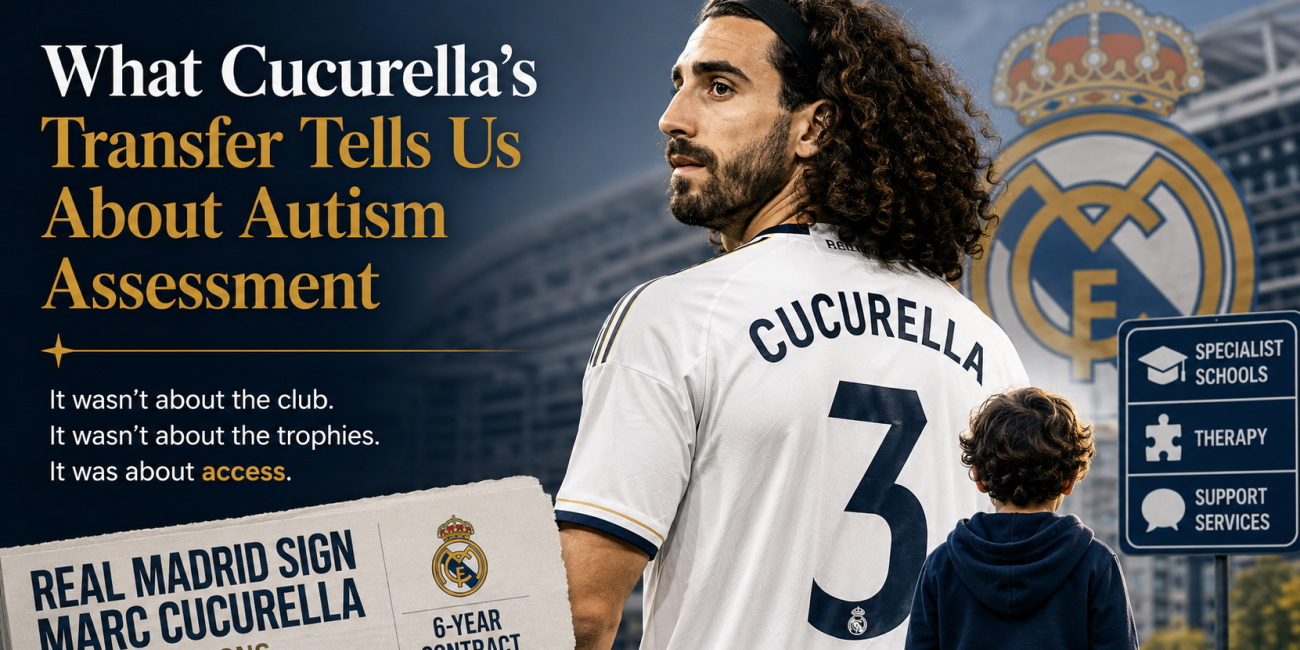
In June, Real Madrid announced the signing of Marc Cucurella from Chelsea on a six-year contract, a deal reported at €55 million and rising towards €60 million with add-ons. The back pages treated it as a football story, and it is a good one: José Mourinho’s first signing of a new era, a Barcelona academy product joining the fiercest rival, a Spain international sealing his future in the middle of a World Cup.
But tucked inside the coverage was a detail that had nothing to do with football, and for hundreds of thousands of families it was the only part of the story that mattered.
Key Takeaway
The Cucurella transfer is an access story. A family with every resource still lost time to wait-and-see advice and the search for answers, and chose cities around provision. For everyone else, autism assessment waiting lists now stretch past 16 months. Remote psychoeducational assessment removes geography from the equation, so answers, and support, can start in weeks.
The detail the back pages skipped
Cucurella’s eldest son, Mateo, is six years old and autistic. His parents have spoken about him openly and deliberately, to make the condition more visible. And in an interview around the move, Cucurella explained how the family had approached every offer that arrived. The first question was never the club, the wages or the trophies. It was whether the city had specialist schools and professionals who could provide his son’s therapy. He was explicit that they would not join a club in any city where they could not find provision that suited Mateo.
Read that again. One of the most sought-after defenders in world football, with all the resources that implies, organised his entire career around a single variable: access.
The road to an answer
The family’s account of the years before diagnosis will be familiar to a great many parents. Mateo was born in Barcelona in October 2019, a few months before Spain locked down. Isolated at home, with no other children to compare him with, the early differences were easy to miss. When music played, he flapped his hands, and his parents read it as dancing; only later did they understand it as self-regulation. He made little eye contact, was slow to speak and often seemed far away, yet he was so affectionate that autism never crossed their minds, because it did not match the picture of autism they carried.
When they raised their concerns, they were told what worried parents are so often told: he is very young, wait and see. Claudia Rodríguez, Cucurella’s partner, has described the period around his first nursery as their worst months, finding little help from the school and walking home from drop-off in tears day after day. The nursery photographs told their own story, the same small boy always alone, always slightly apart. Months of appointments followed before a neuropaediatrician confirmed the diagnosis. Cucurella has said plainly that this is the part he regrets: if they had realised earlier, they could have begun helping him earlier.
Then came the search for the right setting. When the family moved to London, their son started school and was deeply unhappy, and for a while they had no solution. It was Claudia who concluded that he needed a specialist school, because he was neither learning nor enjoying his life; mainstream education, she has said, was not right for him. Finding the setting that was shaped everything the family did next, including, eventually, the terms of a €60 million transfer.
Money was never the bottleneck
Here is what makes this story worth sitting with. This is a family with resources most people cannot imagine, and money solved almost none of it. Money did not make the early signs legible. Money did not silence the wait-and-see advice. What the family actually spent was something else entirely: they spent geography. They chose their cities around provision, and when the biggest club in the world called, the deal was conditional on schools and therapists.
Access, it turns out, breaks down into three things. Access to answers: an assessment that explains what is happening. Access to the right setting: a school that fits the child. And access to ongoing support: the therapy and adjustments that carry on in between. Almost everything downstream queues behind the first. School placements, funding decisions, therapy referrals, classroom adjustments and, later, examination access arrangements all tend to wait, formally or informally, for the assessment.
What waiting actually costs
Most families cannot spend geography. So they spend time. In England alone, NHS data shows well over 200,000 people waiting for an autism assessment, with roughly nine in ten waiting beyond the 13-week standard recommended by NICE, and the National Autistic Society reports average waits now stretching past 16 months. For children referred through community health services, the Children’s Commissioner has reported median waits of more than two years for a neurodevelopmental diagnosis, with a significant minority waiting over four. Other developed countries tell versions of the same story.
Set those numbers against the one thing everyone in this field agrees on: the earlier support begins, the more it changes. A waiting list does not just delay a document. It consumes the exact years in which help has its greatest effect, which is precisely the regret Cucurella voiced about his own son’s path. And his family lost far less time than most.
For international families, the queue resets
Globally mobile families experience this problem squared. A posting changes, and the waiting list resets to zero in a new country, often in a new language, under a new system with its own referral rules. Many cities have no English-speaking educational psychologist at all. Some families, exactly like the Cucurellas, end up making location decisions around provision. Most simply cannot.
Access is a solvable problem
It is worth being clear-eyed about which parts of this are hard and which are not. Building a specialist school takes years. Training a therapy workforce takes years. But the first bottleneck, access to answers, is largely a problem of geography and capacity, and geography is no longer a good reason.
A psychoeducational assessment can now be conducted remotely to the same standard as in a clinic: gold-standard cognitive and attainment measures, a structured developmental history, questionnaires from home and school, and, where the picture indicates it, formal autism assessment, all carried out by HCPC-registered educational psychologists and written into a report that schools and examination boards can act on. The wait is measured in weeks rather than years, from any city with an internet connection.
And while the formal answer is being established, children do not have to wait for paperwork before the adults respond to what is in front of them. Schools can adjust seating, routines, instructions and sensory load on the basis of observable needs. The report matters for what it unlocks, but a child’s needs exist, and can begin to be met, before it arrives.
Most families cannot move to Madrid
Cucurella’s transfer will be remembered for football reasons, and fair enough. But parents heard a different story inside it: a family that had everything, and still found that the scarce resource was never money. It was access, to answers first and everything after. He solved it the only way an elite footballer can, by making access a condition of the contract.
Most families will never move cities for a club. None should have to move cities for an answer.

Alexander Bentley-Sutherland is the CEO of Global Education Testing, the leading provider of Learning Development Testing tailored specifically for the International and Private School community worldwide.
- This author does not have any more posts.